
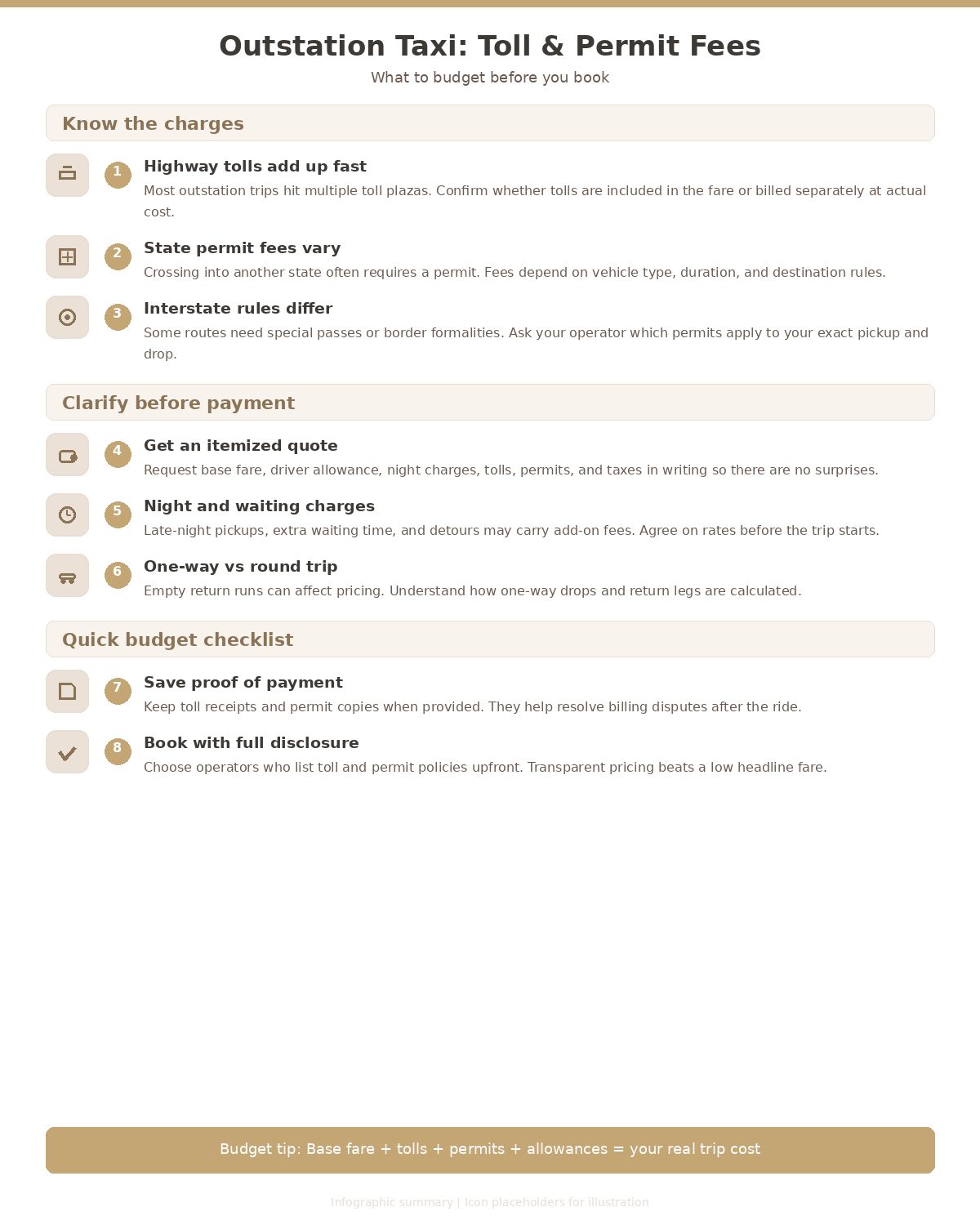
Most travelers who book an outstation cab are surprised by the final bill, and the gap is often 15 to 25 percent above the quoted fare. The base rate looks clean on the booking screen, but outstation taxi toll charges, state permit fees, driver allowances, and night surcharges tend to show up later. If you're planning a trip from Chennai to Puducherry, Madurai, Coimbatore, or a hill station like Ooty, knowing where these costs come from is the easiest way to avoid an argument at the end of the trip.
This guide walks through each cost category we see on real invoices, explains why it exists, and shows you how to check it before you pay. You'll learn how tolls work on national and state highways, what cab permit charges in Tamil Nadu usually cover, and which hidden taxi fare charges are negotiable. We'll also cover the trade-offs between cheap quotes and all-inclusive pricing, because the lowest number is not always the lowest total.
Why the Quoted Fare Is Rarely the Final Fare
Cab companies usually quote a per-kilometer rate, a minimum billable distance, and sometimes a flat package. What they don't always quote is everything that sits outside that rate card. In practice, the quote covers the vehicle and the driver's time for the agreed distance, and everything else is treated as a pass-through cost.
A common mistake is comparing two quotes line by line without asking what each one excludes. One operator may quote a lower per-kilometer rate but leave tolls, permits, and parking out of the total. Another may include tolls but charge a higher minimum distance. Neither quote is wrong. They just answer different questions.
Results vary depending on the route, the time of year, and the vehicle class. A sedan on a weekday trip to Tiruchirappalli will generate a very different bill than an SUV carrying a family to Kodaikanal during a holiday weekend. That's why it helps to build your budget around categories rather than a single number.
- Base fare: the per-kilometer or package rate for the vehicle
- Tolls: highway and expressway charges, usually paid through FASTag
- Permits and taxes: state-level permit costs, entry tax, and GST
- Driver costs: driver allowance (batta), food, and lodging on multi-day trips
- Surcharges: night charges, waiting time, and extra kilometers
- Local fees: parking, hill road entry, and occasionally airport or station fees
Outstation Taxi Toll Charges: How FASTag and Cash Tolls Really Work
Tolls are the most visible cost on an outstation trip, and also the one most often misunderstood. Most national highways in Tamil Nadu now use FASTag, an electronic tag linked to a prepaid or bank account. The toll amount depends on the vehicle class, which is set by the National Highways Authority of India. A sedan is charged differently from a larger multi-axle vehicle, and the rates are revised periodically, so any number you read in an article will eventually be out of date.
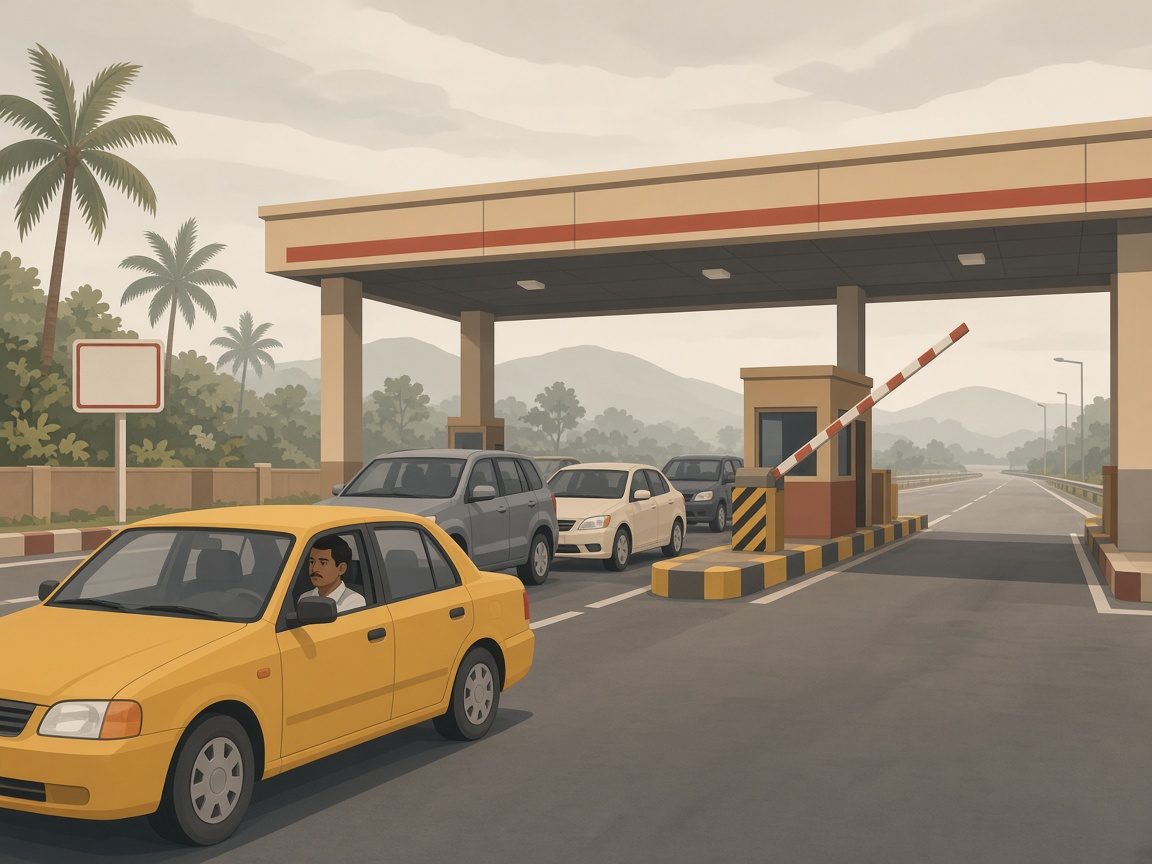
The question most travelers ask is whether the cab company will pass tolls through at cost. In most cases, yes, but the terms differ. Some operators bill the actual toll amount on your final invoice. Others add a fixed toll estimate to the quote and reconcile it later. A few include tolls in the base price and quietly build a buffer into the rate.
The return trip toll trap
A common mistake here is forgetting that the cab has to come back. If you're traveling from Chennai to Pondicherry and the driver returns the same evening, the return journey usually crosses the same plazas. Some operators charge tolls for both directions, others charge only one, and some only charge the return toll if the cab goes back empty. Ask this directly before you confirm.
Expressways and cash lanes
Expressways and some newer corridors have their own toll structures and sometimes their own payment rules. Where FASTag isn't active on a specific lane or the tag balance is low, the driver may pay in cash and expect reimbursement. If you're asked to pay a driver in cash for tolls, request a receipt or at least note the amount and the plaza name on your invoice. Without that record, disputes are difficult to resolve.
Cab Permit Charges in Tamil Nadu: Who Pays and When
Permit costs are the category travelers understand least, and the one where the rules are most likely to differ between operators. A taxi operating in Tamil Nadu needs the correct permit from the Regional Transport Office, depending on whether it's a contract carriage, a tourist vehicle, or a private car used for hire. Vehicles registered in another state often carry an All India Tourist Permit, and operators from outside Tamil Nadu may face state-level tax or permit requirements when they enter.
The practical question for you is simple: does the operator's rate include the permit costs that apply to your trip, and are those costs current? Permits have validity periods and renewal fees, and a well-run operator builds those into a predictable rate. A poorly run one may try to recover the cost on the day of travel.
What to ask about permits

We've found that most disputes about cab permit charges in Tamil Nadu come down to one missing question. Travelers assume the permit is included, and operators assume the traveler knows it's extra. Clarifying this up front avoids most of the friction.
Ask whether the vehicle holds a valid permit for the states you'll pass through, and whether any permit or tax charges apply to your specific route. If an operator says "all taxes included," ask them to name the categories. A good answer names them. A vague answer is a warning sign.
State Entry Tax and Inter-State Charges
When a cab crosses a state border, the vehicle may be liable for entry tax or other state-level charges, depending on its registration and the route. This is most relevant for trips that cross from Karnataka, Kerala, or Andhra Pradesh into Tamil Nadu, or the reverse. Trips that stay entirely within Tamil Nadu usually avoid these charges, which is one reason a short detour can change the total cost.
The rules on entry tax and inter-state taxation have changed several times, and they're worth verifying for your specific vehicle rather than relying on a general rule. Operators who run these routes regularly should be able to tell you whether a charge applies and roughly how much it will be.
Driver Allowance, Night Charges, and Waiting Time
Driver costs are where many budgets break. On a same-day trip, the driver's time is mostly captured in the per-kilometer rate. On a multi-day trip, the driver needs food, lodging, and rest, and those costs are often billed separately as a daily allowance, commonly called batta. The amount is usually fixed per night or per day and is independent of how far the cab travels.
Night charges are a separate line item. Many operators apply a surcharge for travel during late-night hours, often starting around 10 or 11 pm and continuing into the early morning. If your departure is late or your route runs through the night, check the exact window and the surcharge amount before you book.
Waiting time and detours

Waiting time is billed when the cab sits idle for reasons that are part of your trip, such as waiting at a temple, a market, or a hotel check-in. The billing rule varies. Some operators give a grace period of 30 to 60 minutes and then charge per hour. Others charge from the first minute. A detour adds kilometers to the trip and may push you past the minimum billable distance, so a planned stop at a waterfall or a small town can cost more than expected.
In practice, the easiest way to protect yourself is to share your full itinerary with the operator in writing. If the plan changes, tell them before the change, not after. Operators handle planned detours far more smoothly than surprise ones.
Parking, Hill Road Fees, and Minimum Billing
Parking and local entry fees are small individually, but they add up on a long weekend. Hill stations often charge entry or vehicle fees at the town boundary, and parking near popular sites can be expensive during peak season. Airport and railway station pickups may carry their own charges. Most operators pass these through at cost, so keep receipts where you can.
Minimum billing is the other quiet cost. Many outstation packages specify a minimum number of kilometers per day, even if the actual distance is shorter. A one-way trip that covers 140 kilometers may still be billed as a full day if the operator uses a 250-kilometer daily minimum. This rule is standard in many contracts, and it's fair when you understand it. It's frustrating when you don't.
How to Read the Invoice and Negotiate Before You Book
The best time to control hidden taxi fare charges is before the trip starts. Once the cab is on the road, your bargaining position is weaker. A few specific steps make a large difference, and they don't require a long negotiation.
- Request an itemized quote. Ask for base fare, tolls, permits, taxes, driver allowance, night charges, and parking shown separately.
- Confirm the minimum billing rule. Get the daily minimum in kilometers and the rule for multi-day trips in writing.
- Ask about the return toll. Find out whether tolls are charged for the return journey and whether the cab returns empty.
- Set a waiting time policy. Confirm the grace period and the hourly rate for idle time.
- Specify the night window. Agree on the exact hours that trigger a surcharge and the amount.
- Request receipts for pass-through costs. Tolls, parking, and entry fees should come with proof of payment.
- Pay the balance after the trip, not in full upfront. A partial advance is standard, and it keeps the operator accountable for the final invoice.
Negotiation doesn't mean squeezing the driver. Most operators are running on thin margins, and a fair rate protects both sides. What you're really asking for is clarity. A reputable operator will answer these questions without fuss, and their answers will tell you more about service quality than any review.
If you want a broader comparison, our guide on how to choose an outstation cab operator in Tamil Nadu covers vehicle classes, driver vetting, and the questions to ask before you confirm. For a deeper look at fare structures, see our article on how per-kilometer and package pricing differ for intercity travel. Travelers planning a multi-city tour may also find our checklist for budgeting a South India road trip useful.
Frequently Asked Questions
Do outstation cab fares usually include tolls?
It depends on the operator. Some include estimated tolls in the quote, some bill the actual toll amount on the final invoice, and some exclude tolls entirely. Ask for a written breakdown before you book so you know which model applies.
Who pays the cab permit charges for a trip in Tamil Nadu?
The operator is responsible for holding a valid permit for the vehicle. Whether you pay for permit costs depends on how the operator prices the trip. Ask whether permit and tax charges are included in the rate or billed separately.
Are there hidden charges when a taxi returns empty after an outstation trip?
Sometimes. The return journey may incur tolls, the driver may expect a return allowance, and some operators apply a fee for the empty return. Confirm the return policy in writing when you book, especially for one-way bookings.
How much should I budget for driver allowance on a two-day outstation trip?
Driver allowance is usually a fixed amount per night, plus food and sometimes lodging. The exact figure varies by operator and city, so get the number in writing. For a two-day trip, plan for at least one night of allowance and confirm whether food is included.
What is the difference between a per-kilometer rate and a package fare for outstation taxis?
A per-kilometer rate charges for the distance you actually travel, usually with a daily minimum. A package fare sets a total price for a defined route or time window. Packages are easier to budget, but they can cost more if your plans change. Per-kilometer rates suit flexible itineraries.
Can I avoid night charges on a late-night outstation cab booking?
Not always, because night surcharges usually apply to travel during set late-night hours. You can reduce the impact by scheduling an earlier departure or splitting a long journey into two legs. Ask the operator for the exact window and surcharge before you confirm.
Conclusion: Budget the Whole Trip, Not Just the Fare
Three things matter most when you're planning for outstation taxi toll charges and related costs. First, confirm whether tolls, return legs, and permit charges are included in the quote or billed separately. Second, understand the minimum billing rule, driver allowance, and night surcharge before you commit. Third, keep receipts for every pass-through cost so the final invoice matches what you agreed to. Before you confirm your next booking, request an itemized quote from at least two operators and compare them line by line. Add a 10 to 15 percent buffer to the total for parking, waiting time, and small surprises. That single step will make your budget far more reliable than any headline fare.